FAITH AS A WORTHY SACRIFICE (HEBREWS 11:4)
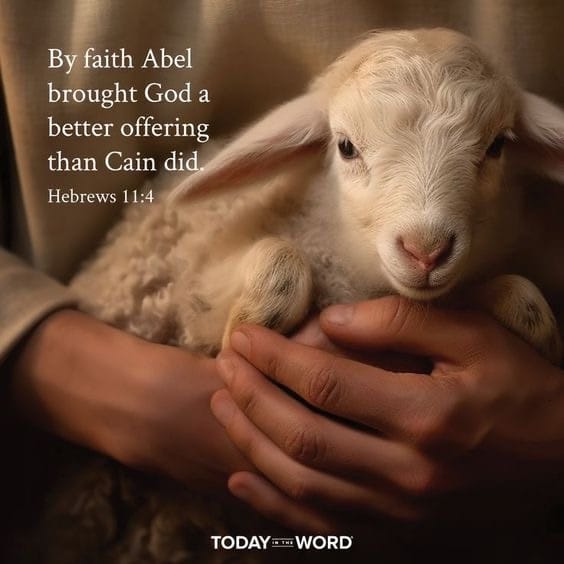
“By faith Abel offered to God a more acceptable sacrifice than Cain, through which he was commended as righteous, God commending him by accepting his gifts. And through his faith, though he died, he still speaks.” Hebrews 11:4 ESV
A. OFFERTORY, TITHE, AND OTHER FORMS OF GIVING
Perhaps one of the most deeply engrained cultures in the body of Christ is giving, especially of offertory and tithe. It is so frequent that it has slowly become a routine, so much so that we often remember that we have to give offertory when the Minister announces it.
Remembering that we did not carry physical cash - we bless The Lord for the quick solution that is electronic money. While this is not exactly a terrible thing, it may sometimes speak to the state of your heart even as you give to The LORD - whether giving to His House is a priority or just an afterthought.
Giving is always a sacrifice. However, as to whether it is a worthy and acceptable sacrifice to The LORD is another story altogether.
B. CAIN AND ABEL
Not long after the fall of man, Adam and his wife had their first children - Cain and Abel. Scripture tells us that Cain tilled the ground while his brother kept the sheep.
I imagine that every so often, their parents told them about a God who always communed with them in the cool of the day, in the most beautiful and lush garden in the East.
They spoke to them of a God whose Glory was once their covering, and of animals which Adam, their father, named in full alignment with that God’s will.
They spoke to them about this God until Cain and Abel eventually met and knew Him for themselves. Knowing God though, is supremely different from encountering Him.
At one point, Eve’s children bring their sacrifices to The LORD. Up until this point, there is hardly (if at all) any record of men sacrificing to God, or God giving instruction concerning the sacrifice He requires. There is no blueprint for the kind of sacrifice that pleases God.
Cain, the first born, presents an offering from the fruit of his land. Abel on the other hand offers ‘the finest first born of his flock and the fat portions’.
Now, Cain does not outrightly refuse to offer anything to The LORD, but he did not deliberately select his sacrifice either. Abel expresses more intentionality, carefully selecting and presenting the best of his first flock and of their fat.
Abel’s sacrifice was accepted by God as pleasing, while Cain’s offering was rejected. The Word testifies that Abel’s faith was counted to him as righteousness.
C. FAITH THAT PLEASES GOD
“But the king (David) said to Araunah, “No, but I will certainly buy it from you for a price. I will not offer burnt offerings to the Lord my God which cost me nothing.” So David purchased the threshing floor and the oxen for fifty shekels of silver.” 2 Samuel 24:24 AMP
Scripture is laced with men who honoured The LORD with their sacrifices. These sacrifices ranged in quantity, from millions of livestock offered by Solomon (1 Kings 3:4), to the last and most precious penny of a widow (Mark 12:41-44).
Everything we have comes from God. The earth and all its fullness is His. (Psalm 24:1) Even the ‘offerings’ we give to The LORD are from what He gave us out of His Abundance. David discovers this, and learns that a broken and contrite spirit is a more pleasing sacrifice to God.
This teaches us that God is not particularly interested in the quantity of the sacrifice. If this was so, He would have absolutely honoured the extravagant sacrifices of the Pharisees in the Temple. Instead, He rebukes them and states that they honour Him with their lips, but their hearts are far from Him. Conversely, he honored the sacrifice of the widow’s coin.
Similarly, The LORD on multiple occasions rejected the sacrifices of the Israelites - considering them a burden to Him because their hearts were far from Him and stained with unrepented sin.
“What are your multiplied sacrifices to Me [without your repentance]?” Says the Lord. “I have had enough of [your] burnt offerings of rams And the fat of well-fed cattle [without your obedience]; And I take no pleasure in the blood of bulls or lambs or goats [offered without repentance].” Isaiah 1:11 AMP
The common denominator therefore revolves around the heart of those offering the sacrifice. God is an examiner of hearts. He dwells in the secret place, so He searches the heart.
This was no different with Abel. At a time when there was no footprint or instruction from God about the kind of sacrifice to offer, Abel settled it in his heart that The LORD deserved his absolute best.
His faith in God was revealed in a careful and intentional selection of the kind of sacrifice that was worthy of The King. His brother on the other hand, did not consider The LORD worthy of his best, but just another potion of his produce.
(Remember the giving of offertory as just another religious routine?)
Any sacrifice to God must originate from a heart that believes in Him and honors Him as LORD, worthy of our best.
When Cain’s face falls because his sacrifice has been rejected, The Lord asks Him:
“If you do well [believing Me and doing what is acceptable and pleasing to Me], will you not be accepted?…” Genesis 4:7 AMP
The Bible teaches us through this Scripture that doing well leads to our acceptance in God’s sight.
Additionally, that doing well in God’s sight involves - first, ‘believing’ Him. We must believe that not only does He exist, but He is a rewarder of those who earnestly seek Him. (Hebrews 11:6)
A heart that believes in and earnestly seeks God offers the best sacrifice to The Rewarder.
In the second place, and having believed God as a rewarder of a heart that seeks Him - we must then offer a sacrifice that is ‘acceptable and pleasing’ to Him.
This instruction is re-echoed in Romans 12:2, where we learn that today, one of the most honorable forms of sacrifice is our own bodies.
D. OUR BODIES AS A LIVING SACRIFICE
“Therefore I urge you, brothers and sisters, by the mercies of God, to present your bodies [dedicating all of yourselves, set apart] as a living sacrifice, holy and well-pleasing to God, which is your rational (logical, intelligent) act of worship.”
Romans 12:1 AMP
The variations of this Scripture all show that our sacrifice must at all times be holy, acceptable and pleasing to Our King.
a) A holy sacrifice
In the Old Testament, when The LORD finally came around to giving instruction concerning the sacrifices to be brought to His House, He required animals without blemish. Animals that were consecrated as holy and set apart for sacrifice to Him.
“If his offering is a burnt offering from the herd, he shall offer a male without blemish; he shall offer it at the doorway of the Tent of Meeting so that he may be accepted before the Lord. Leviticus 1:3 AMP
To be holy is defined to mean sacred, consecrated. The terms ‘blemish’ as used in Leviticus is often used to refer to the stain left by sin and serving other gods. (Joshua 24:14, 2 Samuel 2:24)
To be a sacrifice that is holy and without blemish equates to living a life free of intentional, repetitive sin - and especially serving other gods (including money and the pleasures of this world). A sacrifice that purports to submit both to God while living in sin and idol worship is not holy.
“‘I know your deeds, that you are neither cold (invigorating, refreshing) nor hot (healing, therapeutic); I wish that you were cold or hot. So because you are lukewarm (spiritually useless), and neither hot nor cold, I will vomit you out of My mouth [rejecting you with disgust].” Revelation 3:15-16 AMP
A holy sacrifice is one that is fully sold out to Christ. David describes God in 2 Samuel 24:24 (above) as ‘The Lord my God’ - which teaches us that he honoured God as LORD over his life.
We must equally walk in full obedience and submission to our LORD.
“Therefore, if anyone cleanses himself from these things [which are dishonorable—disobedient, sinful], he will be a vessel for honor, sanctified [set apart for a special purpose and], useful to the Master, prepared for every good work.” 2 Timothy 2:21 AMP
LORD, help us all. 🧎🏻♀️
b) A pleasing and acceptable sacrifice
Likewise, the sacrifice must be pleasing acceptable to Him. This also means that it is possible for your sacrifice to be rejected by God.
“When you offer blind animals in sacrifice, is that not evil? And when you offer those that are lame or sick, is that not evil? Present that to your governor; will he accept you or show you favor? says the Lord of hosts.”
Malachi 1:8)
The same is true for our lives, which we ought to jealously guard to remain honorable and acceptable to The LORD. We do this in so many ways, but principally by guarding our hearts to ensure they are not regarded by our God as ‘sick’ or ‘lame’.
“Run away from youthful lusts—pursue righteousness, faith, love, and peace with those [believers] who call on the Lord out of a pure heart.” 2 Timothy 2:22 AMP
Our hearts must always be kept pure for us to see God.
Again, LORD help us all. 🧎🏻♀️
E. KEEP YOUR ALTAR BURNING
“The fire on the altar shall be kept burning; it shall not [be allowed to] go out. The priest shall burn wood on it every morning, and he shall arrange the burnt offering on it and offer the fat portions of the peace offerings up in smoke on it.” Leviticus 6:12 AMP
Finally, the instruction to ‘present our bodies as a living sacrifice’ implies that this must be done on a continual basis. In the Old Testament where men constantly offered animal sacrifices to God, they were required to ensure a sacrifice was always at the altar, and the fire at the altar never at any one point went out.
The decision to offer your life as a living sacrifice is not one that should ever be taken lightly. Rather, we are required to ‘consistently work out our salvation to bring it to full effect with fear and trembling - using serious caution and critical self-evaluation to avoid anything that might offend God or discredit the name of Christ.’ (Philippians 2:12).
“You shall command the Israelites to provide you with clear oil of beaten olives for the light, to make a lamp burn continually [every night]. In the Tent of Meeting [of God with His people], outside the veil which is in front of the [ark of the] Testimony [and sets it apart], Aaron [the high priest] and his sons shall keep the lamp burning from evening to morning before the Lord. It shall be a perpetual statute [to be observed] throughout their generations on behalf of the Israelites.” Exodus 27:20-21 AMP
As priests to our LORD, the oil we rely on today to keep us burning is The Holy Ghost who causes us to will and to work. A life of constant surrender, repentance, worship, communion and overall submission cannot be overstated.
The Word also requires that the lamp be kept burning ‘throughout their generations.’ As a priest, the perpetual burning as a living sacrifice is not only for you, but your entire household and the generations that will come out of you. (Deuteronomy 6:7)
E. FINALLY…
Our faith is displayed in our works. Our works involve the offering of our lives as consecrated and acceptable to our LORD. This offering is perpetual, continuously offering ourselves to The King up until the day He returns.
In Abel’s day, his sacrifice was accepted as evidence of his great faith in His Creator and Giver of all that he had. Today, he still speaks because of his great faith. He, along with David, Solomon, the widow and many others considered their LORD worthy only of their best.
God calls us to this and an even higher standard to prove our faith.
How set apart is your life as a living sacrifice in full evidence of your faith?